ADAPTIVE BEHAVIOR EVALUATION SCALE
REVISED SECOND EDITION
(ABES-R2)
by Stephen B. McCarney, Ed.D. &
Tamara J. Arthaud, Ph.D.
Copyright © 2006
|
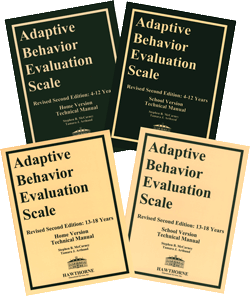
The Adaptive Behavior Evaluation Scale-Revised Second Edition (ABES-R2) provides a measure of those adaptive behaviors which are necessary for success in both an educational and home setting and are not measured by academic skills testing. The ABES-R2 meets the need for an adaptive behavior rating scale which relies on direct behavioral observations by educators and parents/guardians in educational and residential settings. The ABES-R2 is used as a measure of adaptive skills in the identification of mentally retarded, behaviorally disordered, learning disabled; and visually, hearing, or physically impaired students. The ABES-R2 assesses 10 areas of adaptive skills grouped under the three adaptive behavior domains defined in the 10th AAMR Definition of Mental Retardation (AAMR, 2002): Conceptual, Social, and Practical Skills.
The technical manuals include data on internal consistency, test-retest, and inter-rater reliability; item and factor analysis; and content, criterion-related, diagnostic, and construct validity.
|
 |
|
| Characteristics and Components of the ABES-R2 |
 |
- The ABES-R2 is based on the definition of adaptive skills adopted by the American Association on Mental Retardation (AAMR, 2002). The ABES-R2 was factor analyzed to create the factor clusters (domains).
- The ABES-R2: 4-12 SV was standardized on 3,288 students ages 4 through 12 years old. The ABES-R2: 13-18 SV was standardized on 1,897 students ages 13 through 18 years old.
- The ABES-R2: 4-12 HV was standardized on 1,998 students ages 4 through 12 years old. The ABES-R2: 13-18 HV was standardized on 1,034 students ages 13 through 18 years old.
- The standardization population included students from 30 states, represented all geographic regions of the United States, and closely approximated the 2000 demographic characteristics of the United States.
- The ABES-R2 provides norms based on age (4-12 and 13-18) for males and females.
- Internal consistency, item and factor analysis, standard errors of measurement, and test-retest reliability are reported.
(ABES-R2 continued on next page.)
|
|